By Jessica Deutsch, EdM,LSW
I am quite sure everyone who attended at the 2026 Gold Foundation Summit in Pittsburgh this September felt as fortunate as I did to have been there. From the moment Louisa Tvito, MSW, Vice President of Programs, opened the conference by saying, “The Gold community reminds us that we are not alone,” we had entered a sacred space.
That special feeling continued with the opening exercise, which brought the entire room into connection. Do you know the line in the movie Jerry Maguire, by Renée Zellweger’s character, “You had me at hello”?
As a first-time Summit attendee, I would say instead: “You had me at Tell Me More.”
The opening activity prompted attendees to pair up and ask each other the questions on the Tell Me More® poster, filling out a poster with new details to share what was meaningful to their partner. While this was set up as the Summit icebreaker, in a more typical hospital setting, when a student, healthcare professional or volunteer sits down with a patient, the resulting poster about the patient is then hung up on the wall, so all members of the care team can learn more about them as a person, beyond their diagnosis.
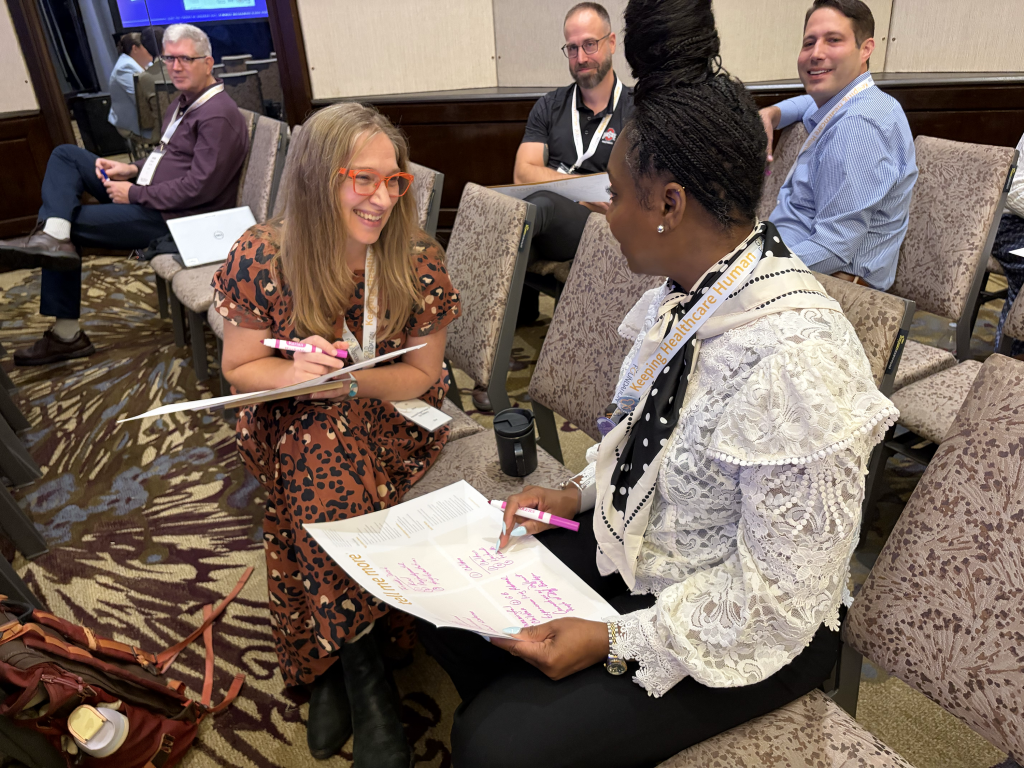
Attendees were given Tell Me More posters to fill out about each other as they paired up for conversation and connection.
Tell Me More® made immediate, intuitive sense to me, on several levels.
- As a social worker, I saw it as an obvious way for hospitalized patients and their families to have their human dignity preserved, ensuring that they would not be reduced to whatever was ailing them or whatever the beeping monitors displayed.
- As the daughter of a physician who had practiced internal medicine for almost four decades, I saw it as a hopeful sign that my father’s modus operandi was alive and well. He believed that patients would only tell doctors what they needed to know if they could trust that they were being seen and listened to as human beings first.
- And as a daughter who had lost her father only months earlier, after a short but painful hospital stay, I was still reeling a bit from knowing firsthand how helpless and stifling my dad’s hospital room felt without the benefit of such a poster.
I saw Tell Me More® concept in action when I paired up with a young resident physician who was sitting next to me and exchanged a few random facts. I hadn’t known a single soul when I arrived at the Summit, but after that simple exercise – known a little bit to just one person—I did feel less alone. I hoped my partner did, too.
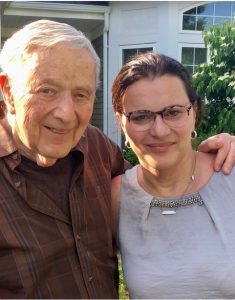
Author Jess Deutsch and her father, Dr.Herbert Lipschutz
Proceeding through the Summit, the affirmations continued. Of course, I was looking for them, both personally and professionally. Grief over my father’s death had led me to The Arnold P. Foundation in the first place. We chose the nonprofit as the organization we would have friends and family members donate to in memory of my father. As a pre-med advisor, who has for years helped young people prepare for lives in medicine, the mission also resonated profoundly. I decided to attend the conference both to honor my father’s memory and for inspiration I could share with the young people I counsel.
There was no shortage of “gold” inspiration across the sessions, large and small.
You could have heard a pin drop when plenary speaker and Vice Chancellor of New York Medical College, Mill Etienne, MD brought us into his consultation room with a colleague who had become his patient — ever so humbly sharing the power of careful listening, the privilege of presence and touch, and the recognition of what can be communicated beyond words.
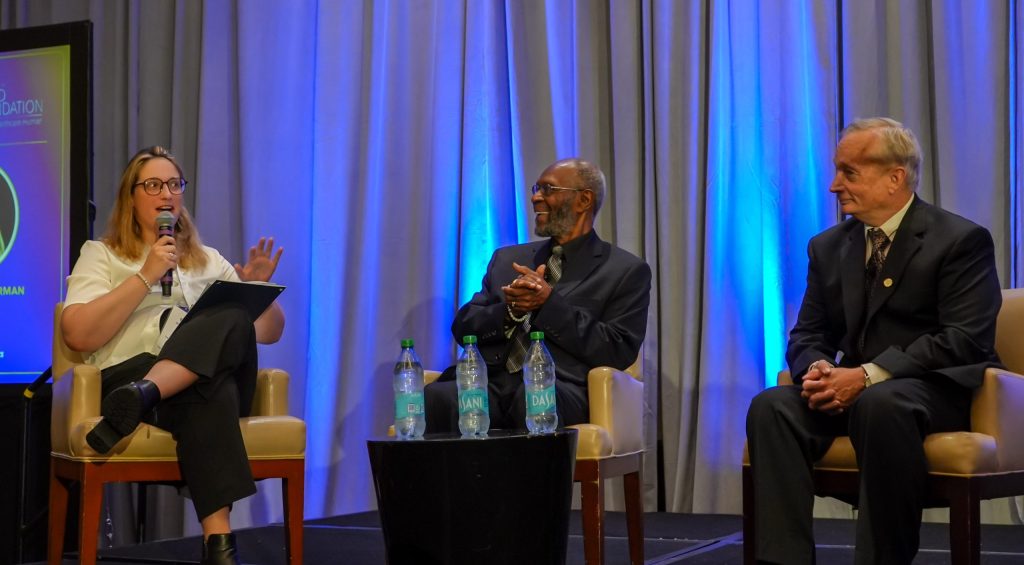
Dr. Emily Silverman in conversation with John Moon and Dr. Jim Withers at the 2026 Gold Humanism Summit.
Could anyone not be moved by the memories of “moving toward the pain,” shared by Street Medicine founder Jim Withers, MD, as he took us under bridges, with borrowed supplies, attending to strangers as if they were members of his own family? He was on the plenary stage in conversation with Freedom House pioneering paramedic John Moon and Nocturnists host and founder Emily Silverman, MD.
How many of us related to what nursing legend Beverly Malone PhD, RN conveyed about the incredible person who motivated her to become a healing professional — a grandmother with minimal education but maximum commitment to caring?
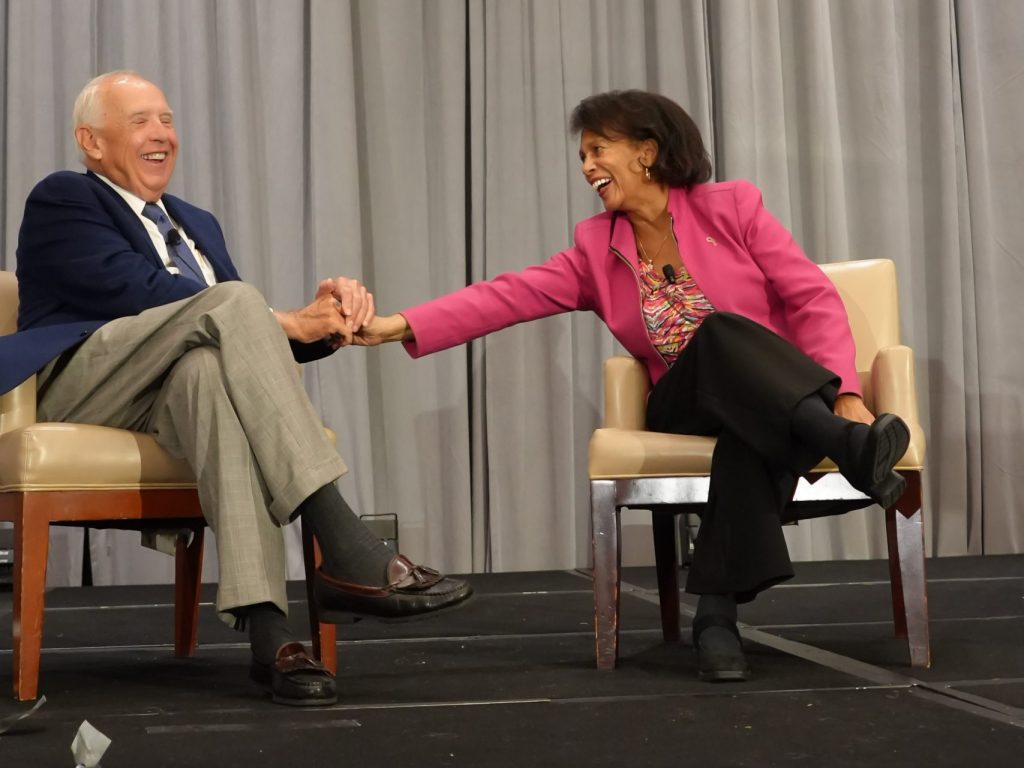
Dr. Darrell Kirch and Dr. Beverly Malone in their fireside conversation at 2026 Gold Humanism Summit.
Who wouldn’t find themselves wishing that every doctor might share a fraction of the vulnerability that Gold Trustee and AAMC President Emeritus Darrell Kirch, MD offered to us in sharing the downs as well as the ups in his ascendency to the heights of healthcare leadership? How much more healing might be possible with that level of truth and humanity?
While weeks now have passed, I find myself still reflecting on the question asked by the medical students in The Healer’s Journey, the documentary we screened with Mick Krasner MD: “Will I be able to hold onto my humanity?” If only they could hear us talking back to the screen, “Yes, you can! Look at all of your colleagues here who have your back!”
The musical interludes linger in my mind as well: The intoxicatingly joyful noise of the Pittsburgh Steeline. The soulful beauty of grace played by a father with his violin and his daughter accompanying him. The musical extremes of joy and sorrow echoed what transpires in medicine, along with everything in between.
Like all the best learning experiences, the Gold Humanism Summit raised more questions than answers. Here are the Top Ten Questions I am still thinking about:
- What can I learn from the person in front of me that data won’t tell me?
- What would make a patient believe her doctor is prepared to hear her truth?
- What kind of doctor will a student become because of the kind of teacher they encountered?
- How do we interrupt the drift toward efficiency over presence?
- What will we do with the time that AI saves?
- How do we get to vulnerability sooner and more frequently?
- How do we build our organizations to be humble?
- What does it take to build a community that values humanism?
- How do we treat disease without losing the person?
- How do I show you I see you, I am here, you have my attention?
What are the questions you are still contemplating from the 2026 Summit? Whose story stayed with you? Whose face are you able to see more fully because of what you learned? What have you been present to differently because of what you experienced in Pittsburgh? What moments of trust, curiosity, and compassion might still unfold because you were there?
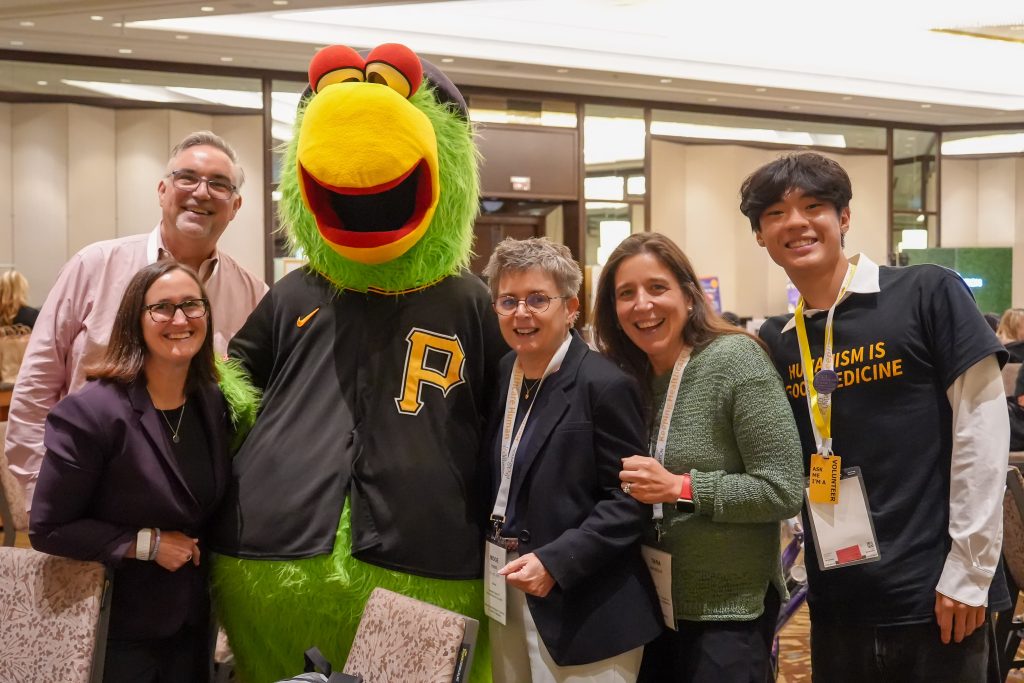
Happy attendees of the 2026 Gold Humanism Summit hang out with the Pittsburgh Pirates’ parrot.
I’m already looking forward to what we might each bring to Salt Lake City next year. Until then, may we hold onto what we can from the city that launched Mr. Rogers neighborhood, John Moon and the Freedom House Ambulance Service, and Noah Wyle’s inspiration for The Pitt.
Written and shared with gratitude to The Arnold P. Gold Foundation for helping us to better see the person in front of us, in all the ways we need to, and in hopes of moving together toward clinically excellent healthcare that is kind, safe, and trustworthy.
Did you attend the 2026 Gold Humanism Summit? Would you like to share your own reflection? Please email Chief Communications Officer Brianne Alcala at balcala@gold-foundation.org. We’d love to hear from you.
The next Gold Humanism Summit will be held Sept. 28-30 in Salt Lake City. Proposals to present a poster or session are currently being accepted. Deadline: Jan. 19. Learn more here.