Earlier this year I was emailing with Brianne Alcala, Gold Foundation’s Editor in Chief, about humanism researchers to highlight in future Research Roundups. In one of those emails she wrote that she had an “idea for a future RR, while my brain is brainstorming.” Her brainstorm was about the importance of sleep for human-centered care — for patients (in the hospital, notoriously noisy and disruptive) and for clinicians (especially residents, who are expected to function while sleep deprived). She named Dr. Laura Vater, a Gold Humanism Honor Society member, oncologist, and popular healthcare voice as one strong advocate on the subject [editors note: see in particular her Stat News First Opinion article How physician exhaustion kills compassion – and nurtures shame and the podcast episode Sleep Deprivation, Burnout, and Occupational Injustice] and added, “There are so many researchers, so I can find some, but hope this is a helpful start.”
It was an absolutely helpful start, and that email exchange seeded this Roundup as well as the realization that not all humanism research looks like humanism research. Sleep is where humanism meets biology, and the researchers who study it rarely use the word “humanism” at all. They publish in sleep medicine journals, diagnostic safety journals, and hospital medicine journals. But the question they’re circling is central to the Gold Foundation’s mission: What does it take for people — clinicians and patients alike — to be treated, and to treat each other, with a holistic humanism lens?
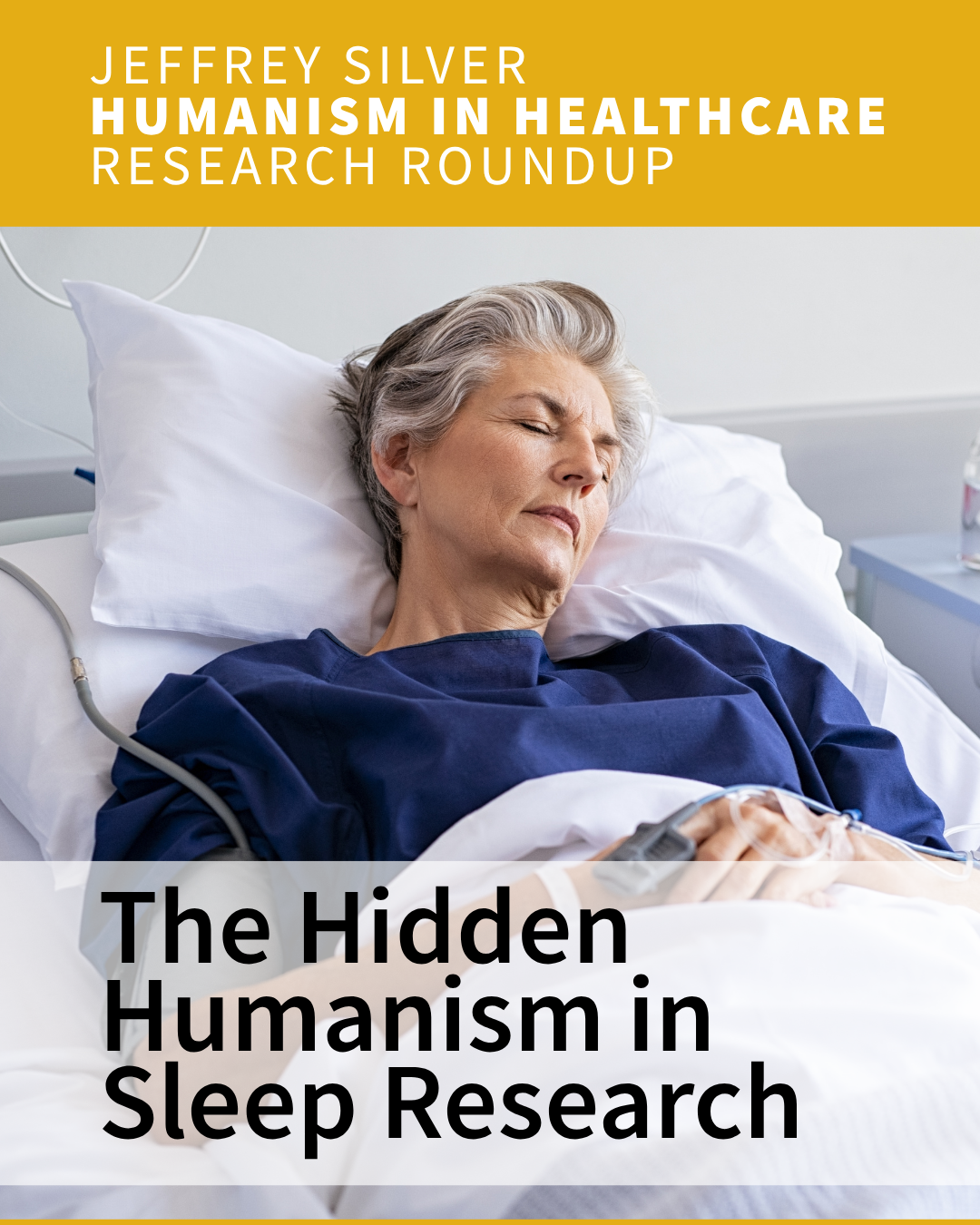 The structure of medical education and the healthcare industry generally produces sleep impairment. Sleep impairment degrades biology, attention, emotional regulation, and the capacity to read another person accurately. Degraded biology produces care that is less humanistic — it is less safe and less kind — and lands on patients and clinicians both, feeding back into the same structures that started the cycle.
A seminal citation here is Dr. Mickey Trockel and colleagues’ 2020 study of over 11,000 physicians. Their research found that sleep-related impairment and burnout are tangled together, fueling each other rather than one simply causing the other, and that both independently predict the odds a physician reports making an error that harmed a patient.
The three articles highlighted below show us that the evidence for sleep being germane to humanism is hiding in plain sight in articles that don’t use the word “humanism.” They suggest that the people most at risk from sleep loss, whether patients or trainees, are usually the ones with the least power to protect themselves from it, and that even a well-designed attempt to change that doesn’t always work as hoped.
Dr. Jordan Fox and colleagues’ systematic review is the first of the three studies in this Research Roundup. It was published in a behavioral sleep medicine journal and doesn’t use the word humanism. It is, in that sense, a direct example of the thesis above.
A Mixed-Methods Systematic Review of Sleep Duration and Quality in Healthcare Workers: Impacts on Patient Safety and Quality of Care. Fox, J., McGrail, M., Cha, Y. J., Cho, D., Lu, R. W., Yi, R., & Martin, P. (2025). Behavioral Sleep Medicine, 23(5), 698-714. Access the Free Article
What: Dr. Jordan Fox and colleagues conducted a systematic review of 30 studies with nurses, doctors, and other allied health professionals. A consistent finding across the studies is that short sleep duration, including that caused by shift work and long hours, is associated with worse patient safety, particularly more errors and poorer cognitive functioning. The evidence related to sleep quality is more mixed and sometimes contradictory.
So What: There is important asymmetry in the data, with sleep duration effects manifesting in consistent and robust ways, while sleep quality effects are more inconsistent and understudied. Quality of care (patient experience, being treated well) has been studied far less than patient safety (errors, mortality).
Now What: The authors argue that regardless of the ambiguity in the data, healthcare workers deserve conditions that support their best work, and patients deserve the best possible care. To work toward this, they suggest institutions explore organizational strategies such as reduced shift length, regular breaks, and better scheduling. Educational interventions recommended include more attention to sleep hygiene and mindfulness-based approaches during training. And for their fellow researchers, they make an explicit call for more experimental/interventional research (not just descriptive studies) and more research specifically on sleep quality and quality of care, not just duration and safety.
Dr. Jordan Fox’s review covers the broader healthcare workforce, nurses, doctors, and allied health professionals, but excludes trainees by design. The next article, Dr. Vincent Capaldi and colleagues’ scoping review, looks specifically at that excluded population: resident physicians.
The Impact of Sleep on Resident Clinical Reasoning: A Scoping Review. Capaldi, V. F., II, Aidara, Y., Flores, B., Dupont, J., Kim, E., Simonelli, G., Durning, S., & Jung, E. (2026). Diagnosis, aop. Access the Free Article.
What: Dr. Vincent Capaldi and colleagues have published the first scoping review specifically examining sleep’s relationship to clinical reasoning and technical skills. It includes 31 studies, both observational and experimental, and covers over 11,500 residents across multiple specialties (mostly surgery and internal medicine). Fifteen studies addressed the impact of lack of sleep on technical skills: three observational studies showed no impact on performance, while 9 of 12 experimental studies showed lack of sleep associated with a decline in clinical reasoning technical performance. Seventeen studies focused on non-technical clinical reasoning: five of 9 observational studies and all 8 experimental studies reported a negative impact of lack of sleep on clinical reasoning performance. Junior residents were consistently more vulnerable: multiple studies found fatigue’s negative impact was greater among less experienced residents, while senior residents tolerated fatigue better. The review found no studies that directly examined whether sleep loss affects the learning of clinical reasoning, only its performance.
So What: The field can describe a real pattern but can’t yet compare precisely across studies, given inconsistent outcome definitions and heavy reliance on self-reported sleep data. Beyond this measurement problem lies another gap: the authors are explicit that no studies have tested whether sleep loss affects the learning of clinical reasoning itself, only performance, even though residency is fundamentally an educational period.
Now What: The authors call for standardized clinical reasoning outcome measures, objective sleep assessment (actigraphy) rather than self-report, and residency schedules tailored by experience level rather than applying ACGME limits uniformly, ensuring more protected rest for junior residents. They also call for longitudinal research on chronic sleep loss and for future studies to test sleep’s effect on learning directly, not just performance.
The first two papers are reviews that map existing evidence and point out where more research, including intervention research, is needed. While focused on patients rather than clinicians, the last article in this Roundup is an example of such research.
A Randomized Trial of I-SLEEP: A Patient Education and Empowerment Intervention on Inpatient Sleep Duration and Medical Sleep Disruptions. Sunderrajan, A., Cursio, J., Mason, N., Byron, M., Martinez, M., Orlov, N., Knutson, K. L., Mokhlesi, B., Press, V. G., Meltzer, D. O., & Arora, V. M. (2026). Journal of Hospital Medicine, 21(8), 881-889. Access the Free Article
Dr. Nicole Orlov is a GHHS member and Leonard Tow Humanism in Medicine Award recipient. Dr. Valerie Press is a Mapping the Landscape grantee. Dr. Vineet Aroha is a Past Picker Gold Challenge Grantee and Mapping the Landscape grantee.
What: Dr. Aashna Sunderrajan and colleagues conducted a single-center randomized control trial of 194 general medicine inpatients. The I-SLEEP (Inpatient Sleep Loss: Educating and Empowering Patients) intervention combined a 5-minute educational video, a sleep hygiene brochure, eye mask, ear plugs, and a notecard prompting three advocacy questions to ask the care team; standard care received only the brochure, eye mask, and ear plugs, a shared baseline intended to isolate the added effect of I-SLEEP’s education and advocacy components. The primary outcome, patient-reported sleep duration, was null, as were the secondary actigraphy-measured outcomes of sleep duration and continuity. A different secondary outcome, patient-reported disruptions, was positive: participants receiving the I-SLEEP intervention reported significantly fewer disruptions from vital sign monitoring, medication administration, and laboratory draws. Further, 83.2% of participants reported feeling empowered to ask their care team to reduce disruptions, but only 40% actually did; the most common reasons given were lack of opportunity, discomfort, and forgetting.
So What: The authors describe the empowerment finding as increased “perceived agency,” while noting education alone didn’t reliably translate into action. Sleep hygiene education and advocacy tools shifted patients’ sense of control and reduced specific, nameable disruptions, without changing the underlying amount or quality of sleep obtained; sleep, they note, is shaped by more than interruptions alone, and illness, pain, and anxiety are barriers that education in patient advocacy alone may not overcome.
Now What: The authors state that additional strategies, such as prompts or staff reinforcement, may be needed to translate patient intentions into action. They call for replication in larger, multisite trials with more diverse populations, for testing whether I-SLEEP combined with approaches addressing stress and discomfort could yield larger gains, and for research on whether patient empowerment could improve long-term sleep hygiene and post-discharge outcomes.
Looking at these articles together reveals a powerful theme: Risk concentrates on whoever has the least power to change their own circumstances. Patients who felt empowered to advocate for their own sleep often didn’t act on it, and fatigue-vulnerable residents work under scheduling rules that don’t account for it. Healthcare systems built around humanism, treating kindness, safety, and trustworthiness as design requirements, may be better positioned to close that risk-empowerment gap than systems that leave humanism to individual patient and clinician effort.
This suggests something beyond the thesis that not all humanism research looks like humanism research: Perhaps humanism deserves conscious attention in research generally, not only in research that names itself as such. In 2017, the ACGME rescinded a 16-hour shift cap for first-year residents, citing insufficient evidence that it affected hospital-level morbidity and mortality. Whether it benefited residents as people, clinical teams, or patients’ own experience of care, these are related questions deserving of equal attention. Safety defined in solely clinical terms may be hindering a more holistic understanding of quality of care.
And that’s why sleep is a subject that matters whether you’re a clinician trying to stay present through a night shift, an administrator setting a schedule, an educator training the next generation of residents, or a researcher deciding what’s worth studying next. My hope is that after reviewing this Roundup, readers will come away recognizing how pervasive humanism is across nearly every corner of healthcare, whether we explicitly name it as such or not.
To receive email notification of future editions of the Jeffrey Silver Humanism in Healthcare Research Roundup, enter your information here and select “Research Roundup” from the checkboxes at the bottom. Read previous posts in this series.