The University of Miami Miller School of Medicine is a new Hippocrates member of the Gold Partners Council, a group of leading schools and health systems committed to humanism in healthcare
“8 Questions” is a Gold Foundation series spotlighting members of the Gold community – doctors, nurses, healthcare professionals of all kinds, students, corporate and hospital leaders, patients, family members, Trustees, staff members, and supporters.
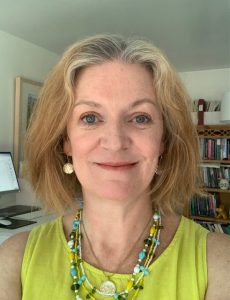
We are delighted to introduce you to Gauri Agarwal, MD, FACP, Senior Associate Dean for Curriculum and Professor of Clinical Medicine at University of Miami Miller School of Medicine. Dr. Agarwal was a Gold Humanism Scholar at the Harvard Macy Institute Program for Educators in Health Professions. Her curricular project explored how the humanities can cultivate empathy while helping learners understand the key applications and limitations of artificial intelligence in clinical practice. She is a Leonard Tow Humanism in Medicine Award recipient and a member and faculty advisor of the Gold Humanism Honor Society.
What drew you to the field of healthcare?
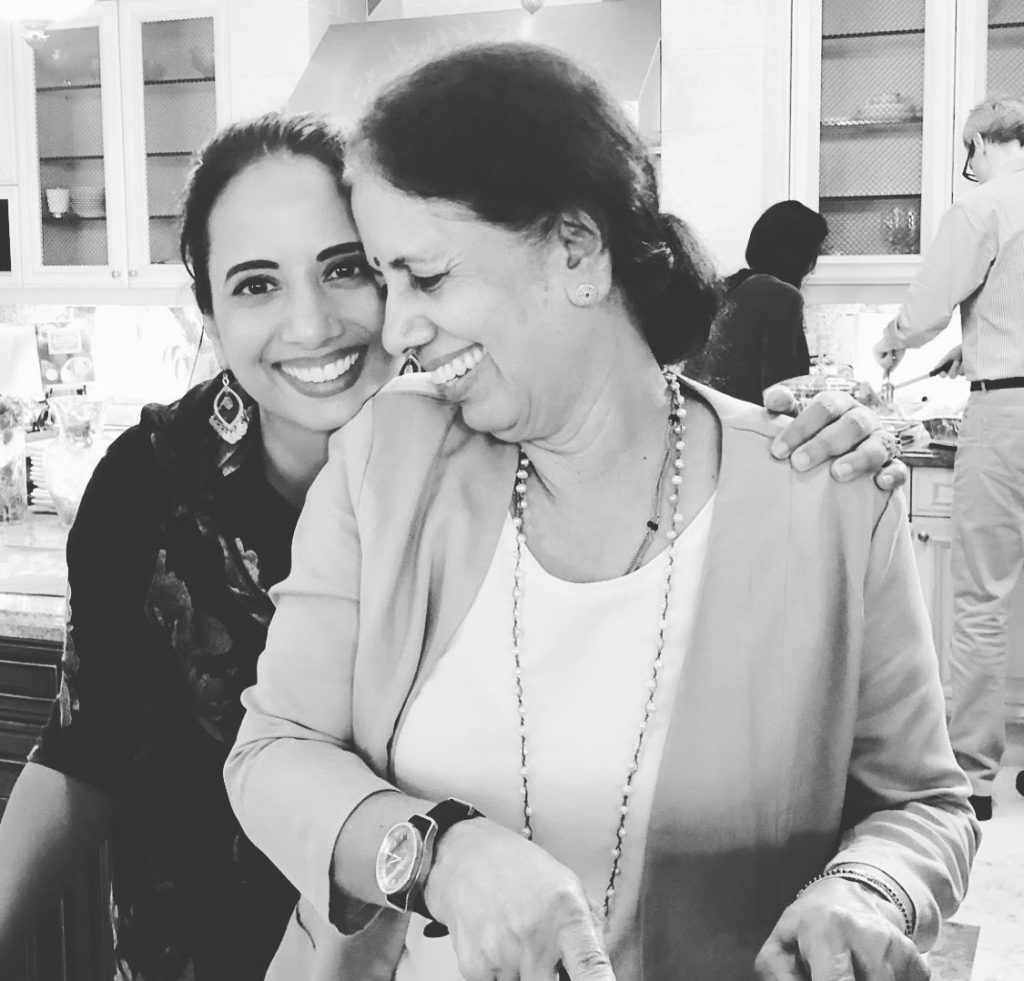
Dr. Gauri Agarwal and her mother
Dr. Agarwal: My mother was my inspiration for a life in medicine. An arranged marriage and a move to the United States in her final year of medical school in India derailed her graduation. It would not be until almost two decades later that she completed medical school and pediatric residency training. I was a witness to her persistence and resilience in completing her training and to her decades of caring for children in the emergency room and in the pediatrics ward. This had an early and lasting influence on my view of medicine as a calling.
What led you to the University of Miami Miller School of Medicine?
The University of Miami is an hour south of my parents and offered a six-year BS/MD program which allowed me to complete medical school at the age of 22. It allowed me to begin my career and family at an early age. I had the freedom of not having to worry about medical school applications and to take classes purely for the joy of learning, like post-colonial literature. My undergraduate years exposed me first to the benefits of humanities training. My medical school experience at UM was filled with opportunities to care for an incredibly diverse group of patients in a rich and robust clinical environment. I completed my residency training at Northwestern and the University of Pittsburgh and returned to join the faculty at UM in 2007. I have been here ever since because of our incredible team of faculty and the brilliant and kind medical students who are drawn to our school.
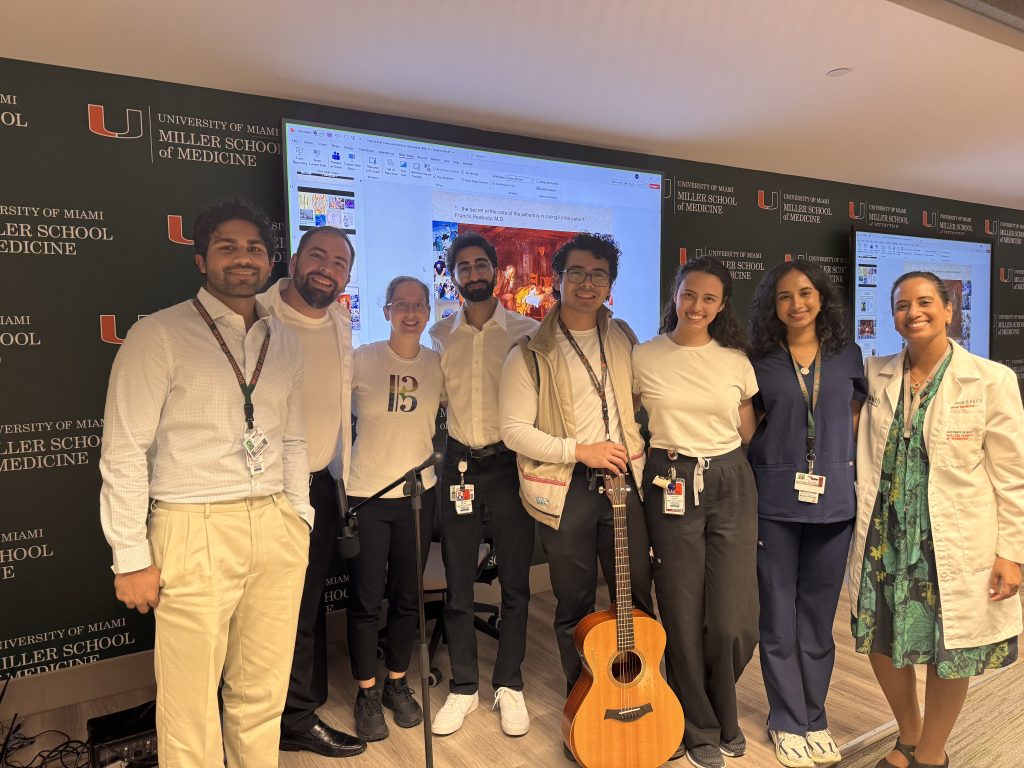
Miller School medical students who are also artists and musicians pose with Dr. Gauri Agarwal after a session on the medical humanities.
The Gold Foundation defines humanism in healthcare as clinically excellent care that is kind, safe, and trustworthy. Why is humanism in healthcare important to the Miller School of Medicine?
All of us in healthcare have the extraordinary gift and privilege of improving and saving lives through our work. I reminded our incoming medical students just a few days ago that all of them would prevent or alleviate the suffering of a fellow human being. Some of them would bring life into this world, and some would be there for someone’s last moments. Our mission is to prepare our students to be worthy of these moments.
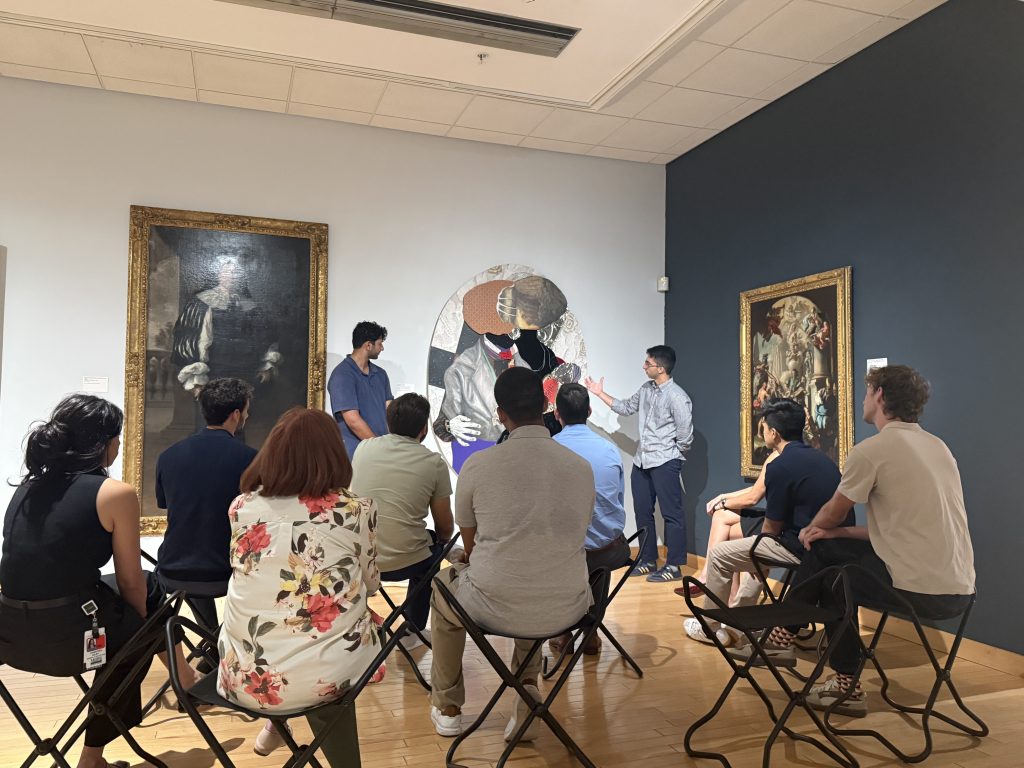
Miller School students reflect on artwork at the University of Miami Lowe Art Musuem during a session designed to build observational skills, understand perspective, and cultivate presence.
How does the Miller School support medical students in becoming humanistic physicians?
I strongly believe that the humanities (e.g. visual art, history of medicine, bioethics, patient narratives, and music) build curiosity, understanding of human experience, and critical thinking. Visual art analysis in particular has many evidence-based benefits in cultivating presence, building observational skills, understanding perspective, and tolerating the inherent ambiguities of a life in medicine. We support the building of these skills in our curriculum, and our students are surrounded by the type of faculty who role model the empathic care of patients. We also support the many student organizations that offer free, accessible healthcare to our community. One particular example that has always stood out for me is our street medicine program started by Dr. Armen Henderson: Read more in the University of Miami Medicine magazine.
Why did the Miller School join the Gold Partners Council?
Our dean, Dr. Henri Ford, is a pediatric surgeon who has modeled empathic care for his entire career, most notably with his work in Haiti following the devastating 2010 earthquake. His humanistic approach to healthcare has been embedded into all aspects of our medical school and being part of this council will allow us to collaborate with a national community of institutions committed to the same ideals. At a time when healthcare is becoming increasingly complex and technology-driven, this has become increasingly important.
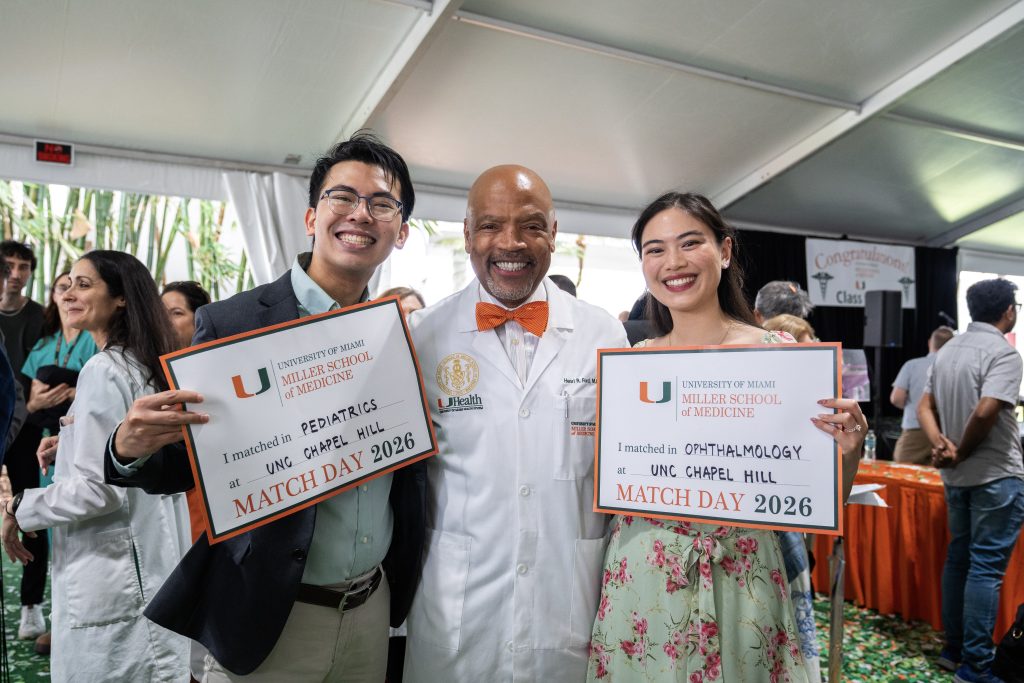
University of Miami Miller School of Medicine Dean Henri Ford with students on Match Day.
Tell us about your work in AI.
My work has focused recently on the thoughtful integration of technology such as AI and virtual reality (VR) into the training of medical students. We have a robust AI curriculum for our medical students, and one of the very first sessions is integrated with the medical humanities. As an example, students engage in a structured analysis of a painting, and we show them the interpretation of that same painting by a large language model (LLM). Although the LLM analysis is often quite detailed and observant, it is not as expansive or creative as our human medical students. Our students draw on lived experience, emotion, intuition, and an understanding of human suffering to make connections the model often misses. We ask our students to reflect on this and how they will approach the integration of these tools into their future practice of medicine. We want them to see that these tools are not a replacement for the human connection that is at the heart of our work. https://www.aamc.org/news/canvases-and-codes-what-visual-arts-can-teach-us-about-power-and-limits-ai
What’s one thing we might be surprised to learn about you or the Miller School?
Harvey, the world’s first cardiopulmonary simulator, was developed at our medical school’s Gordon Center and has been used to train health professionals at hundreds of institutions worldwide. Manikins, models, and encounters with standardized patients all provide powerful opportunities to practice the clinical, communication, and relational skills required of empathic physicians. I view AI in health professions education as an extraordinarily expansive form of simulation. It is a powerful tool for practicing, integrating, and refining skills, but never a substitute for the complexity, dignity, and human connection of caring for a real patient.